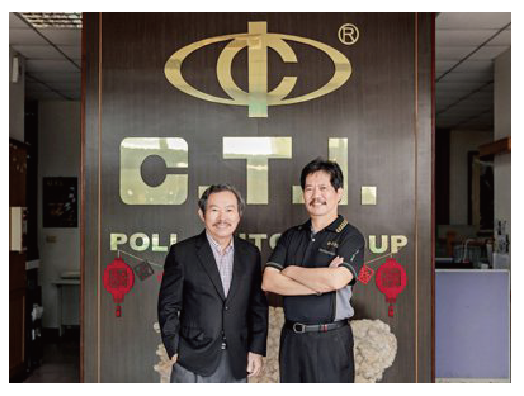
Entrevista do Economic Daily News: a C.T.I. (2230) assenta nos anéis de pistão, que representam 71 % das receitas, a par das bebidas, das refeições coletivas e do armazenamento de energia. A marca CTI vende em 110 países mais de dez milhões de anéis por ano; o seu anel Black Diamond reduz o consumo em 8 % a 10 %; e os seus sistemas inteligentes de armazenamento estão em processo de patente em Taiwan, nos EUA e na UE. A empresa visa uma capitalização de 10 mil milhões de NT$ em cinco anos.
📰 Press coverage: Economic Daily News · Reporter: 蔡武穆
C.T.I. Traffic Industries (2230) is Taiwan’s largest piston-ring manufacturer. Anticipating the coming wave of electric vehicles, it added an energy-storage division four years ago, and it also has subsidiaries in mainland China handling staff catering and liquor — evolving into a diversified group.
C.T.I. Traffic Industries was founded in 1991, taking over the piston-ring equipment and technology of China Traffic Industries (CTI) and carrying the CTI brand forward for 32 years since. Measured by the history of the CTI brand itself, this year is exactly its fiftieth — a full half-century. Piston rings are the main business today at 71% of revenue, with liquor at 16% and staff catering at 6%, while the newly created energy-storage system is under patent application in Taiwan, the United States and the EU and, once certified, is expected to become the company’s second revenue pillar. A piston ring is a critical component of a car engine — without it the engine cannot produce power. The market was once held by American, Japanese and German majors; C.T.I. built its own CTI brand to compete, and after more than thirty years of effort now produces over ten million rings a year, sells into 110 countries, and has broken up that three-way dominance.
Walk through the C.T.I. plant and you see operators measuring carefully with rules and gauges, angles and tapers all having to be exactly right. Chairman Lu Wan-hsien says, "Piston rings look like blue-collar work — on the surface it is just grinding, but there is a great deal of skill hidden in it." General manager Lu Wan-chieh says, "If it were only grinding, we could never compete on price with the small plants." C.T.I. therefore puts its weight behind people and R&D, seeking breakthroughs in patents; from its founding it secured a number of patents on steel oil rings, standardising production and enabling volume manufacture, and stood out among many small makers. Lu Wan-chieh notes that a piston ring is a living thing and depends heavily on people: a fixed part can be picked up by a robot arm, but a piston ring has a gap — grip it too hard and it breaks, too gently and the machining is imprecise, so full automation is not easy. "A sleeve or a piston takes only three machines to finish. The piston ring is the hardest — it takes at least fifteen machines!" The technical barrier is high indeed. Over more than thirty years C.T.I. has continually absorbed foreign technology and experience and acquired quality plants to make technical adjustments, so as to keep pace with the international majors.
Lu Wan-chieh says C.T.I. wins on lead time and customisation. The American and Japanese majors all work to planned production and need six months to ship; C.T.I. needs only three months, and can ship in as little as sixty days — highly attractive to overseas customers. On top of that, large customers have special requirements that ordinary small plants cannot take on, whereas C.T.I. accepts them all, using them to raise its QC and production capability, gradually winning customers over and building a reputation in the market.
Piston rings began as a traditional auto-parts industry, but C.T.I. paid particular attention to energy saving in its development work. Ten years ago, working with ITRI, it used diamond-like carbon film technology to develop the Black Diamond piston ring, which lowers the ring’s friction coefficient and saves at least 8–10% of fuel. It has since been adopted by major international companies and has become C.T.I.’s weapon in the OE market, as well as sowing the seed for the later energy-storage business. C.T.I.’s markets today are concentrated in North and South America at over 45%, with its Panama subsidiary acting as the transhipment point for Central and South America; broken down further, the United States, Mexico and Brazil are the main sales countries, and the US market in particular has been cultivated for a long time and carries real weight with customers.
In China, the Zhejiang Puli subsidiary specialises in the domestic market, producing three to four million ring sets a year and winning on high mix and low volume, with faster lead times than other plants. Its steel oil rings and Black Diamond rings in particular are well regarded by Chinese OEMs and the aftermarket — when high quality comes up, the CTI brand comes to mind, which is real competitive strength. Lu Wan-chieh says the CTI brand is known internationally and not easily displaced by competitors; prices are adjusted to market demand, but the company will not fight price wars or track competitors’ pricing up and down, and that is its greatest advantage. Despite the weak economy since last year, C.T.I.’s orders have kept growing, with many large manufacturers ramping up orders after testing, as the brand effect comes through.
With the world pushing hard to cut energy use and carbon, electric vehicles have become an important development area — and an EV has no engine, so it needs no piston rings. C.T.I. saw the danger four or five years ago and began looking for a transformation, moving towards the energy-storage industry. Lu Wan-chieh says that because automotive batteries carry higher risk, and the compensation for an accident would be substantial, they do not suit the company’s constitution; C.T.I. therefore set its sights on residential, commercial and industrial storage systems. It has completed 1KW, 5KW, 10KW and 50KW smart storage systems and filed for patents in Taiwan, the United States and the EU simultaneously; two have been granted and the third is under review. The smart storage system it has developed charges from both solar and mains power and can be set and controlled remotely from a phone app. He explains that five to eight in the evening is the demand peak, and that with electricity priced higher in that window in future, green power stored during the day can cut the bill — peak shaving and valley filling.
Lu Wan-hsien is likewise positive on the storage trend. He explains that the EU has already begun levying a border carbon tax, and that factories will have to save energy and cut emissions; those that miss their carbon targets will have to buy carbon credits to export goods. A storage system produces green power and helps manufacturers cut energy and carbon, which is genuinely forward-looking. Once the 50KW patent is granted, the company will continue towards 100KW and 200KW as a focus of future development. Although it is pushing hard on storage, it will not neglect the existing piston-ring business: Lu Wan-chieh says electric vehicles are the future trend, but as things stand they are only 15–20% of the global car market, combustion cars remain the mainstream and the aftermarket is still very large, so C.T.I. will keep expanding abroad, pursuing new customers and holding its leading international position.
The catering and liquor businesses are advancing in parallel. C.T.I. had already invested in Chihshang Bento, run by Taiwanese businesspeople in mainland China and serving the Taiwanese community there, and has now expanded into liquor sales. Demand for liquor in mainland China is large, and it already accounts for 16% of that operation’s revenue; as the market expands, revenue will climb further. Chairman Lu Wan-hsien puts C.T.I.’s thirty years of standing firm in the market down to innovation and systems: whether in piston rings or storage, keeping an innovative attitude at all times is what keeps the company at the leading edge. Second, only sound systems produce good teams — every department at C.T.I. can operate independently and innovate to achieve its best performance. C.T.I. recently introduced employee share subscription: "However much an employee invests, the company matches it — so for half the money they can own company shares," letting employees grow with the company and strengthening their commitment.
Lu Wan-hsien says C.T.I. is not a single business: it now has subsidiaries developing in a range of industries and can withstand any economic shift. Across the whole layout — from traditional industry out into new energy, and on into liquor and staff catering — the constitution is more solid than ever. Market capitalisation is currently around NT$4 billion, and the hope is to become a NT$10 billion company within five years.
© C.T.I. Traffic Industries Co., Ltd. Conteúdo original da C.T.I. — é proibida a reprodução, cópia ou uso comercial sem autorização.
Voltar