The five root causes of engine carbon deposits, their symptoms and how to remove them — plus how electrical stability and a piston ring’s sealing, oil-control and heat-transfer jobs decide carbon build-up and engine life. With five animated diagrams.
From combustion conditions and operating patterns to piston-ring sealing and oil control, here is a clear look at how engine carbon deposits form, what symptoms they cause, and how to prevent them.
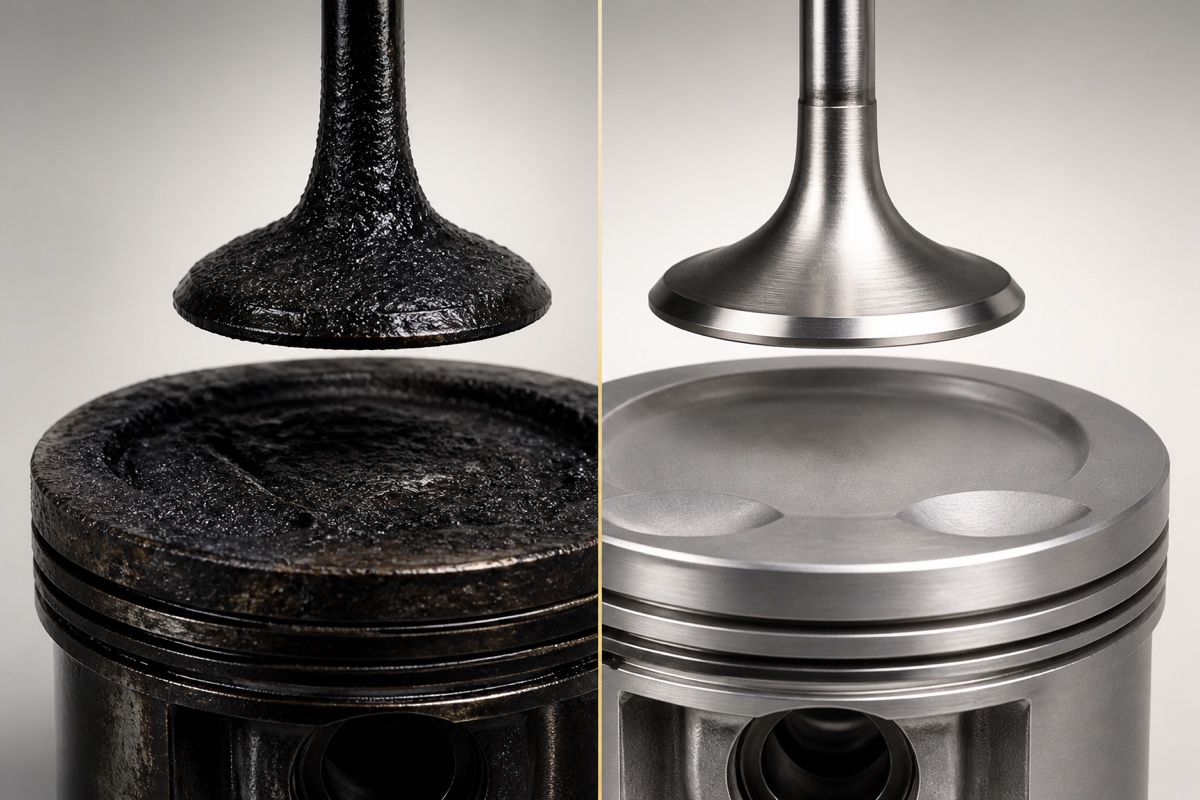
During the operation of an internal combustion engine, a certain amount of carbon deposition within the combustion chamber is a common phenomenon. Engine carbon deposits form mainly on the piston crown, the combustion-chamber walls, and around the valves, gradually increasing as the engine accumulates operating hours.
Put simply, fuel never achieves 100% complete combustion, and the leftover gums and carbonized matter build up layer by layer on the inside of the engine, much like the grease that cakes onto a kitchen range hood. As long as fossil fuels are used, neither gasoline nor diesel engines can fully avoid carbon deposits; the only difference is the rate of accumulation.
The air-fuel mixture ratio directly affects how completely combustion proceeds. When the mixture is too rich or combustion conditions are less than ideal, some fuel fails to burn completely, and the residual hydrocarbons gradually crack and carbonize in the high-temperature, oxygen-starved environment to form hard deposits. Common deposit locations are the piston crown, the combustion-chamber walls and the underside of the cylinder head, the intake and exhaust valve surfaces and valve seats, and the injector tips.
The higher the content of heavy fractions, olefins, and aromatics in the fuel, the more gum and carbon residue it tends to leave behind after combustion. When fuel with insufficient detergency additives is used over the long term, deposits build up noticeably faster on the injectors and intake valves.
Oil that enters the combustion chamber and cracks under high heat is one of the main sources of sticky carbon deposits. There are three common paths: poor piston-ring oil control (a worn oil ring with reduced scraping ability, excessive ring end-gap, or ring-groove carbon causing the rings to stick), aged valve stem seals (oil seeping down along the valve guides), and a blocked crankcase ventilation (PCV) system that sends oil-laden gases back into the intake manifold.
In a conventional port-fuel-injection (PFI) engine, fuel is sprayed onto the back of the intake valve, providing a washing and cleaning effect. In a gasoline direct-injection (GDI/TSI/FSI) engine, fuel is sprayed straight into the cylinder, so the back of the intake valve loses that washing action; combined with EGR exhaust gas and PCV oil-vapor blow-back, intake-valve carbon becomes the classic problem of direct-injection engines, with symptoms typically appearing after 50,000 to 80,000 km.
| Operating Pattern | Chamber Temp. | Carbon Tendency | Notes |
|---|---|---|---|
| Long-term low RPM, low load | Low | High | Deposits are hard to dislodge, building up layer by layer |
| Medium load, normal cruise | Moderate | Medium | A normal rate of accumulation |
| Moderate mid-to-high RPM driving | High | Low | High heat and high flow velocity help suppress deposits |
| Prolonged high RPM, high load | Very high | Med–High | Thermal load and oil consumption rise, which can increase deposits in turn |
There is some basis for this claim, but it needs to be understood correctly:
If your vehicle shows any of the following, carbon deposits are worth considering:
The guiding principle for carbon deposits is prevention over removal. Owners can manage the following items themselves:
| Maintenance Item | Recommended Practice | Recommended Interval |
|---|---|---|
| Oil change | Use the correct viscosity and certification grade per the manufacturer's specification; for turbo/direct-injection vehicles, low-ash (Low SAPS) oil is recommended | 5,000–10,000 km or per manufacturer |
| Oil filter | Replace together with the oil; do not extend its use | Every oil change |
| Air filter | Inspect and clean regularly to avoid a rich mixture caused by restricted intake | 10,000–20,000 km |
| Fuel selection | Use fuel that meets the manufacturer's recommended octane rating and contains detergency additives | Every fill-up |
| Fuel-system cleaner | Choose products containing PEA (polyetheramine); avoid cheap additives of unknown origin | Every 5,000–10,000 km |
| Driving habits | Avoid prolonged idling; every 1–2 weeks include a stretch of mid-to-high-RPM driving (after coolant temperature is normal) | Ongoing |
| Spark plugs | Regularly check the burn color and gap, which reflect combustion condition | 20,000–100,000 km depending on material |
Everything discussed so far has concerned fuel, oil, and driving habits. There is one more frequently overlooked variable: electrical supply stability. A modern engine's ignition and fuel injection are entirely electrically driven, and once the voltage becomes unstable, combustion quality fluctuates along with it.

C.T.I.'s Green Power 2.0 Smart Accelerator connects a supercapacitor in parallel with the vehicle battery. Think of it as a buffer reservoir beside the electrical system: it charges during normal operation and, when an instantaneous high-current demand arrives, discharges within milliseconds to fill the gap and suppress voltage sag.
Once the voltage is stable, ignition energy and fuel-injection quantity become more consistent and combustion completeness improves—this is the same principle behind "fuel savings" and "power gains," presented in three ways, and slowing carbon buildup is just one of the accompanying benefits.
No battery removal, no ECU modification—ready to use right after installation. The change in power is noticeable the moment it is installed, while fuel economy takes about a week of observation.
Reduces new formation: stable power keeps ignition and injection more consistent and combustion more complete, cutting off at the source the carbon that keeps forming from incomplete combustion.
Gradual cleaning: with more complete combustion and a steadier combustion-chamber temperature, sustained driving helps gradually reduce the softer deposits inside the combustion chamber, delivering a gentle, ongoing cleaning effect.
Better paired with professional cleaning: for stubborn carbon that has hardened at high temperature, and for the deposits on the back of the intake valves in gasoline direct-injection engines, it is still best paired with professional cleaning (such as walnut blasting) for optimal results.
The degree varies with vehicle condition: vehicles with a degraded battery, frequent short trips, or higher age usually feel the improvement more clearly.
Learn more: Green Power 2.0 Smart Accelerator
| Method | Applicable Area | Effectiveness | Considerations |
|---|---|---|---|
| Fuel additive (fuel cleaner) | Injectors, combustion chamber | Mainly preventive | Ineffective against intake-valve carbon in direct-injection engines |
| Supercapacitor stabilizer (Green Power 2.0) | Combustion chamber (via more complete combustion) | Gentle, gradual | Cuts new carbon and gradually clears softer deposits; hardened carbon still needs mechanical cleaning |
| Induction / no-disassembly cleaning | Intake tract, combustion chamber | Moderate | Watch the catalytic-converter and cylinder-wall risk from flaked debris |
| Walnut Blasting (intake-valve cleaning) | Direct-injection intake valves | High | Requires removing the intake manifold and specialized equipment |
| Manual cleaning by disassembly | Combustion chamber, piston crown, valves | Most thorough | High cost, usually done alongside a major overhaul |
Having covered carbon deposits, we must return to the component that is both the start and the end of the story: the piston ring. It is the only dynamic interface between the piston and the cylinder wall, and though tiny in size, it shoulders three mutually competing jobs at once.
Keep the explosive pressure sealed inside the combustion chamber. A sealing failure means blow-by: compression pressure drops, power fades, and hot exhaust gas accelerates oil degradation.
Scrape back excess oil and leave the thinnest film needed for lubrication. Too thick and it burns oil and forms carbon; too thin and lubrication is insufficient, wearing the cylinder wall.
About seventy percent of the heat the piston absorbs is conducted through the ring pack to the cylinder wall and carried away by the cooling system. Poor contact is the beginning of piston overheating and scuffing.
Piston-ring design is a series of trade-offs. Raise the tension and sealing and oil scraping improve, but friction losses and fuel consumption rise with it; lower the tension and friction drops, but you may get increased oil consumption in return. To meet fuel-economy and emissions regulations, modern engines keep lowering ring-pack tension, which makes the ring's dimensional precision, material, and surface treatment more critical than ever—the slightest deviation in tolerance shows up directly in oil consumption and blow-by.
Insufficient piston-ring oil control leads to oil migration and more carbon; ring-groove carbon, in turn, makes the rings stick and lose spring tension, and once sealing fails, oil consumption and blow-by worsen further. This is exactly why "cleaning carbon alone" often has limited effect on high-mileage vehicles—if the real source is the ring pack, you must address sealing and oil-control ability.
Piston rings work long-term in an environment of high heat, boundary lubrication, and high-speed reciprocating sliding, so material and surface treatment directly determine their service life. Common approaches include the choice of cast-iron versus steel ring bodies, nitriding to increase surface hardness, and DLC (diamond-like carbon) coating to lower the friction coefficient and wear rate. Good surface treatment keeps the ring pack conforming and scraping oil over long-term high heat, reducing oil consumption at the source and thereby suppressing the carbon cycle at the source.
Further reading: Types and Functions of Piston Rings Piston Ring Surface Treatment Technology (Including DLC Diamond-Like Carbon Coating)
There is no fixed mileage interval. Port-injection engines often need no special treatment up to 100,000 km; for gasoline direct-injection engines it is advisable to inspect the intake-valve condition every 40,000–60,000 km. The real criterion is symptoms: evaluate cleaning when you notice rough idle, hard cold starts, power loss, or an abnormal rise in fuel consumption.
Only partially. Mid-to-high RPM raises combustion-chamber temperature and exhaust flow velocity, slowing loose, soft deposits, but it does almost nothing for carbon already hardened at high temperature, especially the deposits on the back of the intake valves in direct-injection engines, because that area never contacts the combustion flame. It must also be done only after coolant and oil temperatures are normal.
The piston ring performs three jobs at once: sealing combustion pressure inside the combustion chamber, controlling the oil-film thickness on the cylinder wall, and transferring roughly seventy percent of the piston's heat out to the cylinder wall. Failure of any one of these shows up directly as power loss, increased oil consumption, or piston overheating, which makes the piston ring a critical component that determines engine efficiency and service life.
Yes, it helps. A supercapacitor can supply instantaneous current within milliseconds and suppress voltage sag, keeping ignition energy and fuel-injection quantity more consistent and combustion more complete. Beyond reducing newly forming carbon at the source, sustained driving also helps gradually clear the softer deposits inside the combustion chamber. For stubborn carbon that has hardened at high temperature, and for the deposits on the back of the intake valves in gasoline direct-injection engines, it is best paired with professional cleaning (such as walnut blasting) for optimal results.
Yes, and the relationship runs both ways. Carbon building up in the piston ring grooves causes the rings to stick and lose their spring tension, reducing sealing and oil-scraping ability so that oil migrates up into the combustion chamber; the migrated oil then cracks under high heat to form even more carbon, creating a vicious cycle.
Fuel cleaners containing PEA (polyetheramine) have a preventive and mildly cleaning effect on injectors and the combustion chamber, and are suitable for regular use every 5,000–10,000 km. But because fuel additives travel with the fuel, they do nothing for the intake-valve deposits on the back of the valves in gasoline direct-injection engines.
There is risk only if the wrong method is chosen. Aggressive chemicals that strip off large chunks of carbon in a short time can produce debris that scratches the cylinder wall or clogs the catalytic converter; on older engines, carbon that was filling clearances can, once removed, leave behind blow-by or oil consumption. It is best to choose a method of appropriate strength based on mileage and vehicle condition, and to have it evaluated by a professional technician.
Carbon deposits cannot be entirely avoided, but through the right choice of oil and fuel, sensible driving habits, and regular system inspection, the rate of accumulation can be kept within a reasonable range. Among the factors within our control, electrical-supply stability determines whether combustion can burn cleanly, while the piston ring's sealing and oil-control ability determine whether oil migrates upward—one governs the quality of combustion going in, the other governs whether excess oil ends up being burned, and together they form the on/off switch of the carbon cycle.
Since 1973
In piston-ring and engine-component manufacturing since 1973, C.T.I. uses precision machining and surface-treatment technology to help customers maintain engine sealing and oil control under long-term operation, supplying piston rings for automotive, motorcycle, agricultural-machinery, and industrial engines to both OEM and aftermarket specifications.
© C.T.I. Traffic Industries Co., Ltd. Original content by C.T.I. — reproduction, copying or commercial use without permission is prohibited.
Back