Animated walkthrough of an inline-four engine: the four-stroke cycle, the 180° crankshaft and 1-3-4-2 firing order, two-stroke vs four-stroke, cylinder layouts (inline / V / boxer), petrol vs diesel, and where piston rings sit and what they do.
Pop the hood, and every sound of the engine running is really thousands upon thousands of precisely repeated "heartbeats." A four-cylinder engine idling completes roughly 400 full cycles per minute—six times faster than a human heartbeat—and every one of them has to seal in a blast of over 50 bar of pressure.
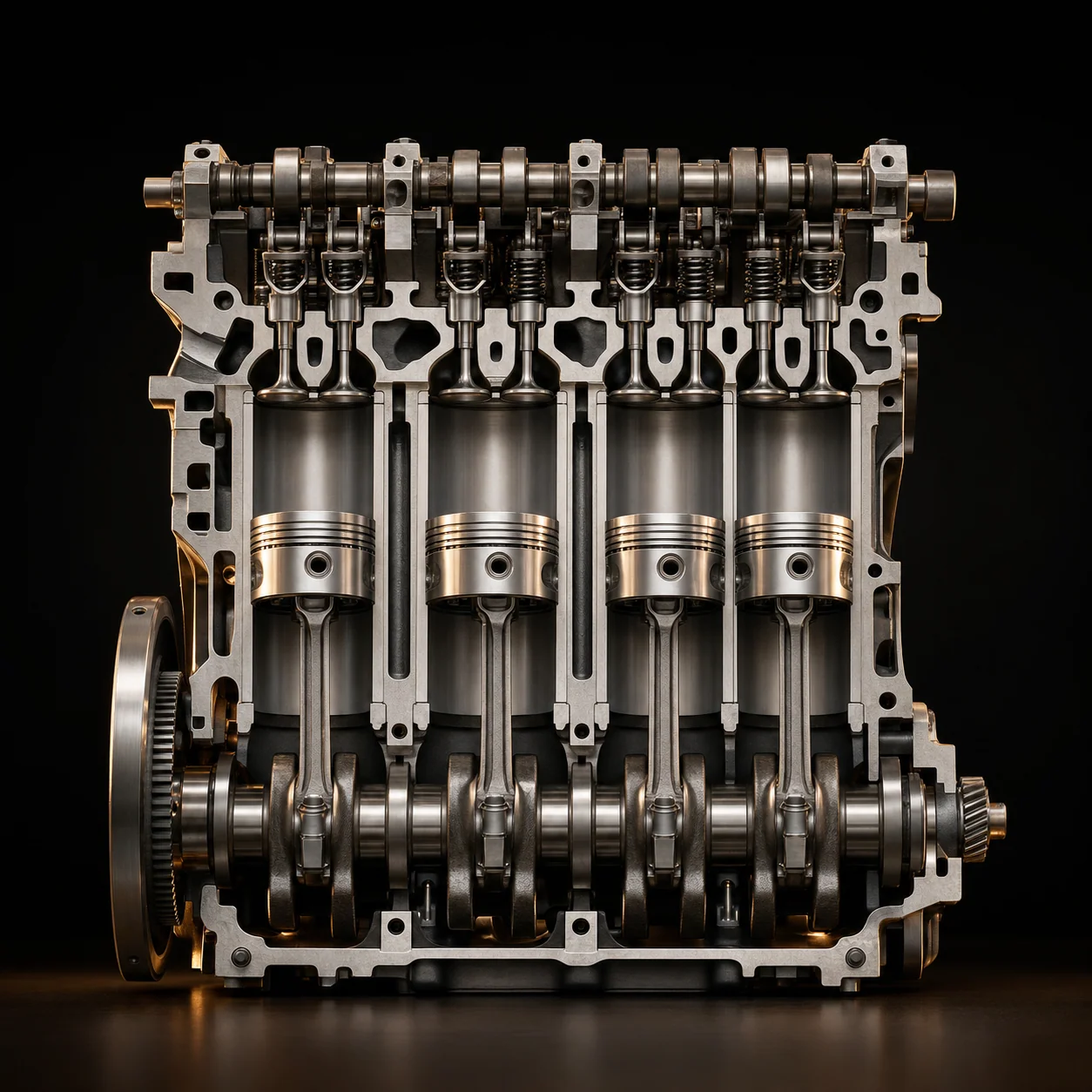
The vast majority of car engines are "four-stroke" engines: the piston makes two round trips up and down inside the cylinder (the crankshaft turns twice, for a total of 720°) to complete one power output. The four strokes, in order, are:
① Intake—the piston travels down, the intake valve opens, and fresh air (or air-fuel mixture) is drawn into the cylinder; ② Compression—the valves close completely and the piston rises, compressing the gas to high temperature and high pressure; ③ Power—the mixture is ignited and explodes, and the high-pressure gas drives the piston down; this is the only stroke that actually does "work"; ④ Exhaust—the exhaust valve opens and the piston rises to push the spent gas out. Then the next heartbeat begins.
But "how many strokes it takes to make one power stroke" actually has another answer—
For every power output a four-stroke engine completes, the crankshaft has to turn two full revolutions (720°); a two-stroke engine packs intake, compression, power, and exhaust into a single revolution (360°)—it fires once for every turn of the crankshaft. Doing away with dedicated intake and exhaust strokes, it instead uses "ports" in the cylinder wall together with the piston itself acting as a valve. The design is simpler and, for the same displacement, the output is fiercer.
The automotive mainstream. Intake, compression, power, and exhaust are each independent, giving complete combustion, clean and fuel-efficient running, and precise valve control.
Common in lawnmowers, chainsaws, and older motorcycles. High output for the displacement, and lightweight, but with higher fuel consumption and emissions.
Watch the animation closely and you'll notice something interesting: the four pistons don't each go their own way—they move in crossing pairs. Cylinders 1 and 4 always go up and down together, while cylinders 2 and 3 do the exact opposite. Many people, seeing this for the first time, ask: is it broken? In fact, this is the very essence of the inline-four.
The secret is in the crankshaft. The crank pins of an inline-four are arranged 180° opposed: the crank pins of cylinders 1 and 4 point the same way, while those of 2 and 3 point the opposite way. This design serves two purposes:
One: it keeps power continuous. Every 180° the crankshaft turns, one cylinder enters its power stroke, and the four cylinders relay each other neatly across the full 720°. The firing order is 1 → 3 → 4 → 2 (not 1-2-3-4), so the combustion location hops back and forth between the front and rear of the engine, and the crankshaft is loaded more evenly.
Two: it cancels vibration. As two pistons rise, the other two fall, and their inertial forces offset each other, so the engine doesn't shake all over like a single-cylinder motorcycle. That's why it looks like "the two sides crossing"—it's a deliberately engineered dance of balance, not a coincidence.
The animation just now was an Inline engine—four cylinders standing in a single row. But there's more than one way to arrange cylinders, and different arrangements change an engine's height, width, and vibration characteristics—and, in turn, the direction of the forces acting on the piston rings. The three most common arrangements:
The simplest construction and cheapest to service, it's the absolute mainstream for four-cylinder family cars. More cylinders make it long, and the I6 is naturally superbly balanced.
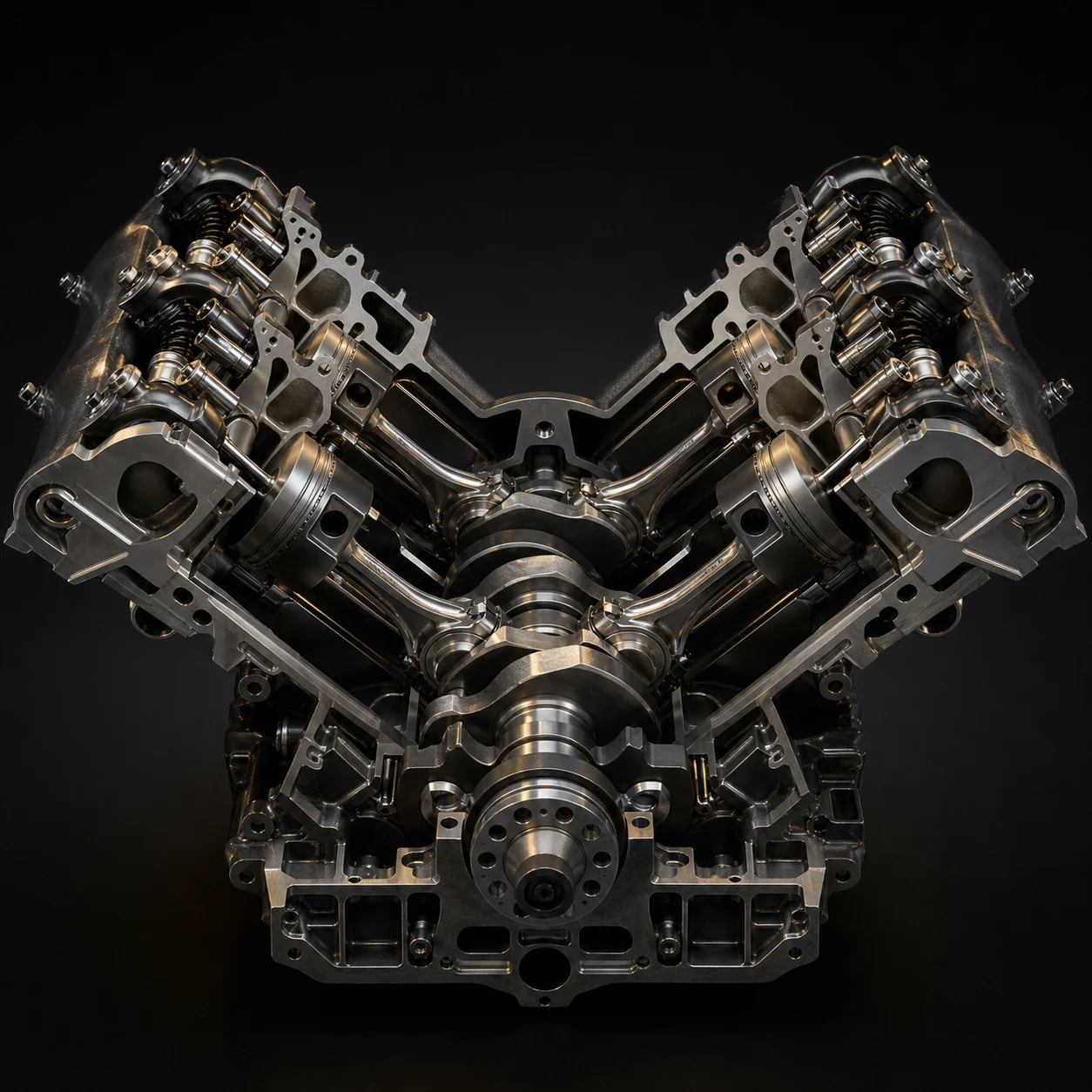
Two banks of cylinders share a single crankshaft, set at a 60°–90° angle. Length is greatly reduced, allowing more cylinders to be packed in—the favorite of performance and luxury cars.
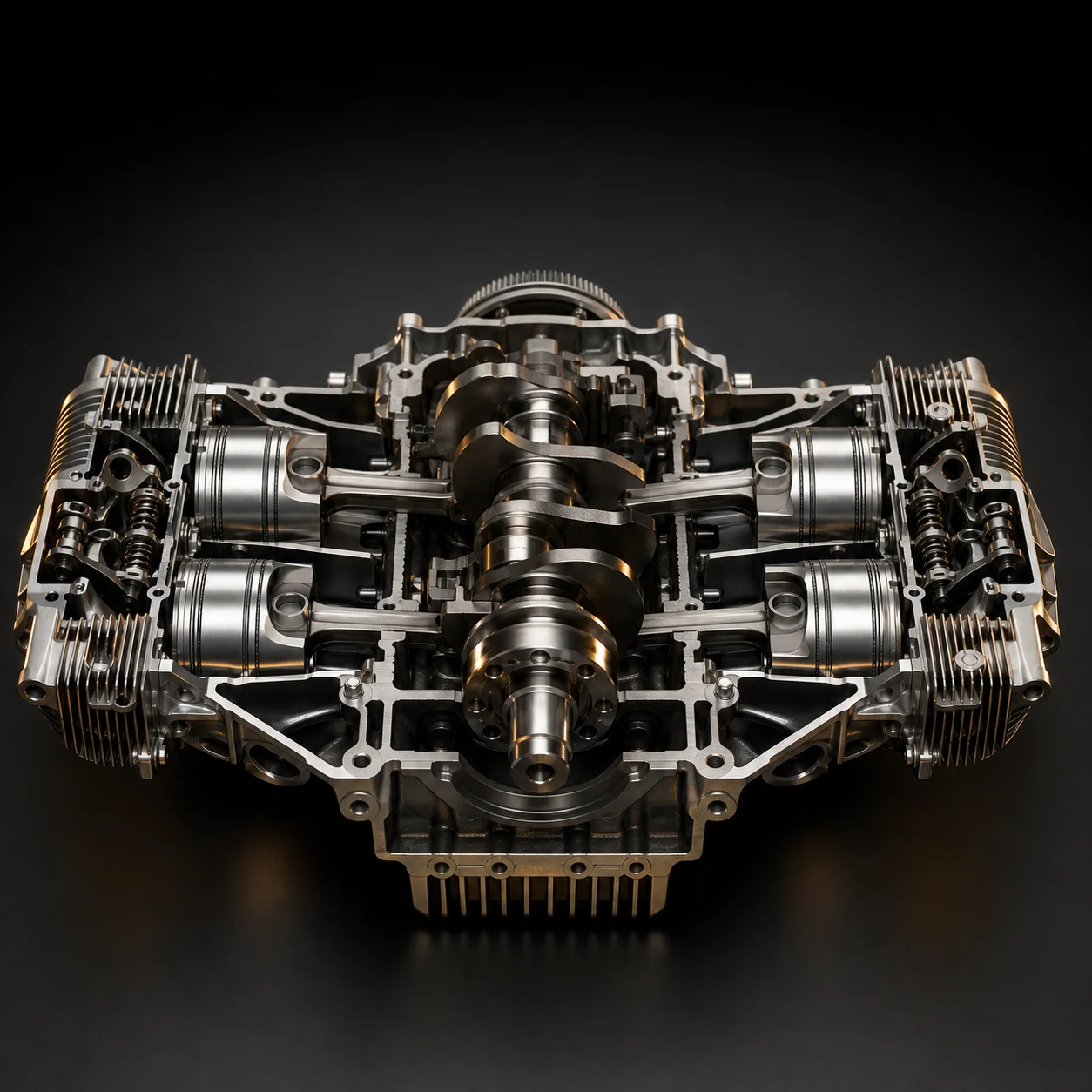
The pistons punch horizontally against each other left and right, their inertial forces canceling out, for minimal vibration and a very low center of gravity. The signature of Subaru and Porsche, but pricier to maintain.
A diesel engine's four-stroke rhythm is exactly the same as a gasoline engine's; the difference lies in "how it ignites." A gasoline engine draws in an air-fuel mixture and, after compressing it, ignites it with a spark from the spark plug; a diesel engine draws in pure air only, uses a compression ratio as high as 16–22:1 to squeeze that air to over 500°C, then injects diesel through a high-pressure injector so it ignites instantly on its own—no spark plug needed at all.
| Item | Gasoline engine (SI) | Diesel engine (CI) |
|---|---|---|
| Ignition method | Spark plug ignites the mixture | High compression makes diesel self-ignite, no spark plug |
| Compression ratio | About 10–14:1 | About 16–22:1 |
| In-cylinder combustion pressure | Lower, about 60–100 bar | Higher, up to 150–200 bar |
| Thermal efficiency | About 30–35% | Over 40%, more fuel-efficient |
| Characteristics | High-revving, smooth and quiet | High torque at low revs, ideal for heavy loads and long hauls |
| Piston ring design focus | Thinner rings, low tension, PVD/DLC coatings | Keystone rings, thicker sections, chrome/ceramic hard facing |
The heart can pump blood effectively because its valves ensure blood flows only one way and never back. An engine is the same: there must be a clearance between the piston and the cylinder wall for it to slide, yet the high-pressure gas from combustion absolutely cannot leak out through that clearance—and the part standing guard is the piston ring.
Piston rings are fitted into the ring grooves on the top side of the piston. The standard setup is three rings from top to bottom, each with a different job:
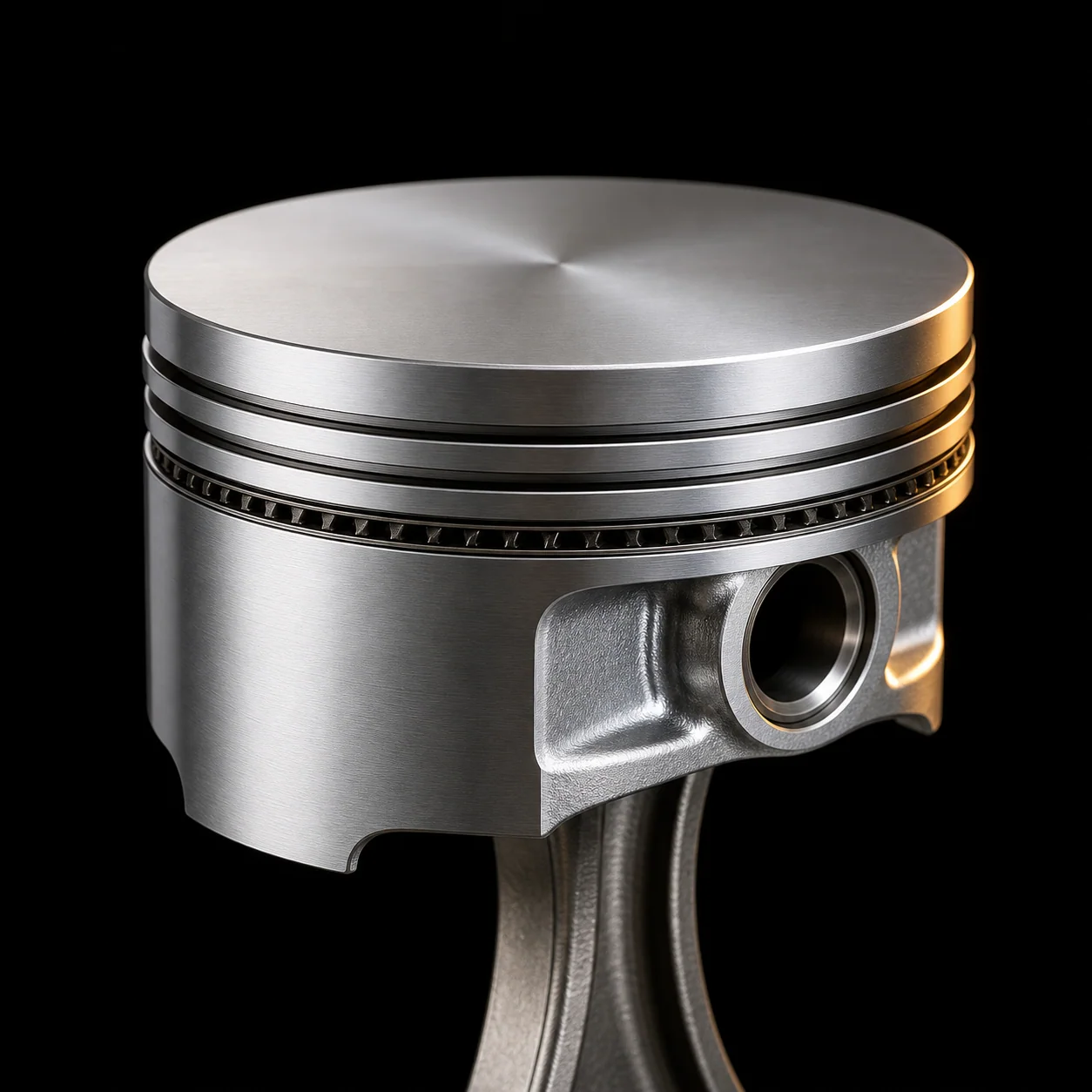
Don't underestimate these three rings of metal. Piston rings have to seal, scrape oil, and conduct heat all at once, in an environment of 300°C, thousands of up-and-down cycles per minute, and almost no lubrication, and hold up for over 200,000 kilometers. Their material, cross-sectional shape, and surface treatment are each craftsmanship built up over decades.
And because gasoline and diesel engines have different "heartbeat intensities," their piston ring designs head in two completely different directions: gasoline engines chase low friction and fuel economy, making rings ever thinner and lower in tension, paired with PVD and DLC diamond-like carbon coatings; diesel engines, facing double the combustion pressure and a carbon-laden environment, switch the top ring to a keystone cross-section to prevent sticking, and fight wear with thick, hard-facing coatings like chrome plating and ceramic.
Of the three rings, the oil ring at the very bottom has the most exacting construction. It has to do two opposite things at once: spread just the right oil film on the cylinder wall for lubrication, and scrape excess oil back to the sump so it doesn't get into the combustion chamber and burn. To balance scraping force with conformability, the oil ring is usually not a single ring but an assembly of several parts. There are two mainstream constructions:

Made of two side rails top and bottom sandwiching a spacer expander in the middle. The two thin steel rails each conform to the cylinder wall on their own for excellent conformability, scraping oil cleanly with low friction—the mainstream in modern thin-ring gasoline engines. Common types: RIK/NPR/PC/TP/U-Flex/Hump Spring.

Made of a one-piece ring body plus a coil expander behind it, the expander providing uniform radial tension. With a thick section and high rigidity, it's often used in diesel and heavy-duty engines. Materials include steel, cast iron, and ductile iron.
C.T.I. Traffic Industries has been deeply engaged in piston ring manufacturing since 1973, supplying gasoline and diesel engine ring sets to the global aftermarket across a complete range of specifications including cast iron, steel rings, chrome plating, and DLC. Every heartbeat of the engine has us standing guard.
© C.T.I. Traffic Industries Co., Ltd. Original content by C.T.I. — reproduction, copying or commercial use without permission is prohibited.
Back