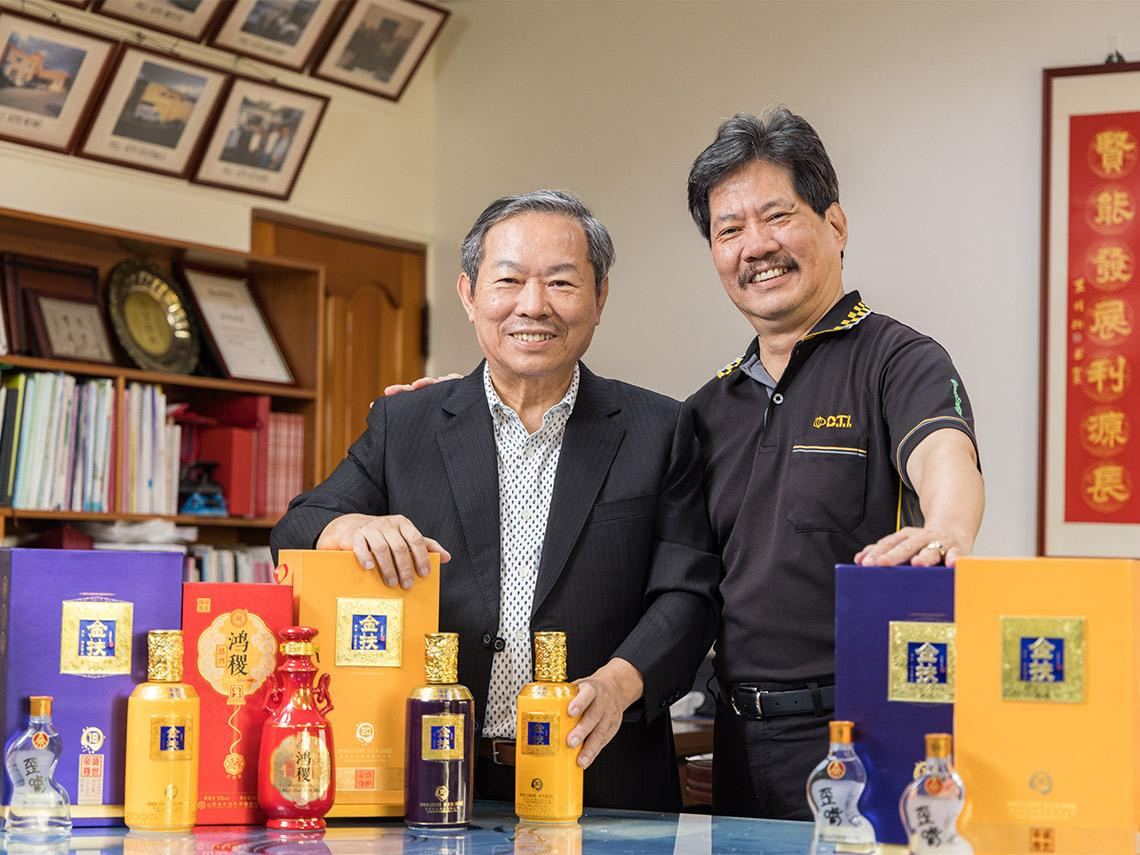
Business Today dosyası: Çin'in içki pazarına girdikten sonra C.T.I. dokuz aylık 1,04 milyar NT$ gelir ve 5,12 NT$ hisse başına kâr açıkladı — bir önceki yılın üç katı. Yazı, Lu kardeşlerin ticaretten üretime, oradan da yeni iş kollarına uzanan yolunu anlatıyor.
📰 Press coverage: Business Today
At a time when traditional manufacturing is in decline, one legacy manufacturer has tripled its profit in the space of a single year by daring to cross into another business entirely.
That company is C.T.I. Traffic Industries, Taiwan’s largest maker of automotive piston rings. After moving into China’s liquor market last year, it has driven both revenue and profit to record highs this year. Revenue for the first three quarters reached NT$1.04 billion, already ahead of the whole of last year, and EPS of NT$5.12 was three times the year-earlier figure.
In the first three quarters of this year, the liquor business accounted for more than 70% of total revenue, while piston rings — once the bulk of it — fell below 30%, contributing an average of just over NT$70 million a month. Even as the core business keeps shrinking in scale, C.T.I. is one of the few Taiwanese makers to have held on as smaller plants were acquired or squeezed out one by one, and it remains the largest.
Success across the divide has lifted the share price with it: from NT$32 in 2022 it climbed past the NT$100 mark, peaking at NT$193 this year. Even after easing back to NT$155 in early December, it is still four times higher than two years ago.
So what prompted Taiwan’s largest automotive piston-ring maker to "stray from its trade" and start selling baijiu?
In truth, moving into a new line of business is nothing new for chairman Lu Wan-hsien and general manager Lu Wan-chieh.
Back in the 1980s, C.T.I.’s first-generation founder Lu Hsiang-li started out trading auto parts, and as it happened became sworn brothers with the founder of China Traffic, who held Japanese piston-ring technology. In 1991, seeing that China Traffic’s second generation had no intention of taking over, the Lu father and son seized the moment, bought its plant and technology, and founded C.T.I. — a formal move from trading into manufacturing.
With their trading background, their first step was to target export markets. Lu Wan-hsien recalls that to win customers at the time, C.T.I. took on everything, special specifications and small orders alike — building both trust and technical know-how. Later they developed patented products such as the Black Diamond piston ring, which combines durability with fuel savings, and their customers now span 110 countries.
But no business runs smoothly forever.
In recent years the rise of electric vehicles has challenged piston-ring products used in conventional combustion cars, and with production lines disrupted by shipping problems during the pandemic, C.T.I. posted losses in both 2020 and 2021, with a peak quarterly loss of over NT$7 million. Operations stabilised after the pandemic, but the Lu brothers realised that without moving early the company would not survive in the long run.
This time, they had their eye on Beihai Duyu Songhao E-Commerce, a baijiu distributor holding the China agency rights for Jinfu liquor, which had decided to sell up last year because of a funding shortfall.
C.T.I. duly acquired it through its Chinese subsidiary Zhejiang Puli, and now distributes Jinfu as well as Moutai and Wuliangye — China’s number one and number two by revenue — in Jiangsu and Henan provinces, at unit prices ranging from a few tens of renminbi to over nine hundred. Since the third quarter of last year the business has added an average of over NT$100 million a month to the company’s turnover.
The logic of the liquor trade is very different from manufacturing. So what qualified them to run it?
As it turns out, Lu Wan-hsien graduated from the food science department of National Chung Hsing University (now the department of food science and biotechnology) and has both an interest in and an understanding of the food and beverage market. Observing that Taiwanese businesses were setting up plants across China and needed catering outsourced, he bought Jiangsu Chihshang Bento around 2016 and focused on staff catering.
Having entered China’s food and beverage sector, he found that even with soft domestic demand, liquor remained indispensable at the table — from staff dinners to executive entertaining. That inelastic demand convinced him to move in boldly.
C.T.I. also signed a product display and sales agreement with an affiliate of China Tobacco, which has some 300,000 to 400,000 retail outlets across the country, allowing it to get products on shelves quickly. Lu Wan-hsien would not disclose the exact number of outlets stocked, but stressed that the current revenue is the best evidence of the expansion.
It all looks like plain sailing, but having your fate in the hands of a single channel carries risk. Recently C.T.I. has opened another route, working with Chinese e-commerce platforms JD Liquor World and Jiuxian to sell nationwide online.
One Taiwanese businessman with long experience in China observes that with Chinese consumption trading down — even Moutai has fallen around 15% — C.T.I. may face price competition, all while it cannot undercut the brands’ market positioning.
Lu Wan-hsien’s answer is to bring in value-priced liquor, such as Wuliangye’s 100ml "Waizui" at little more than NT$100 a bottle, aimed at younger, lower-spending drinkers. "Everyone knows Wuliangye, but few have heard of Waizui. We pick the less famous products under the big brands where there is still market demand."
Lu Wan-hsien is optimistic that C.T.I. will keep expanding both its outlets and its product range: "We want to add one province a year in physical retail, and grow revenue 20 to 30% a year."
Beyond liquor, C.T.I. has not given up on its core piston-ring business and is actively looking for new market opportunities. "A company doesn’t just do whatever is easy today and drop the rest when it gets hard. That is what sustainable operation means," Lu Wan-hsien says firmly.
He believes combustion cars are at least 15 years away from being phased out, and that in the meantime the company will look actively for acquisition targets such as automotive panels, and move into energy storage to connect with the EV field as soon as it can.
From trader to manufacturer, and then into liquor and energy storage, continually digging out new opportunities — that is C.T.I.’s route to lasting. Whether it can pull off another transformation will test the Lu brothers’ judgement.
© C.T.I. Traffic Industries Co., Ltd. C.T.I. özgün içeriğidir — izinsiz çoğaltmak, kopyalamak veya ticari amaçla kullanmak yasaktır.
Geri