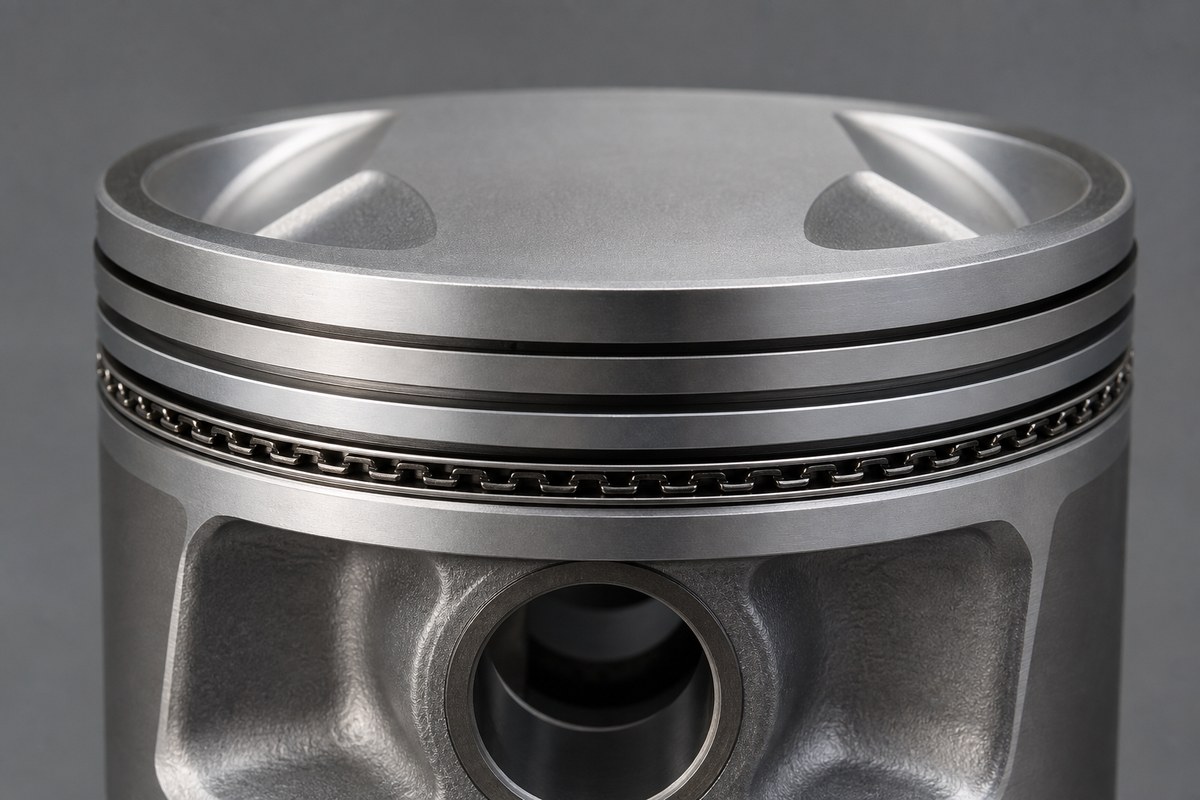
A piston-ring set is usually made up of two compression rings and one oil ring. This article explains how piston rings are composed and their four key functions: sealing, oil regulation, heat conduction and support.
A piston ring is an elastic metal ring that can expand outward and deform, fitted into the grooves of a piston. It is used widely across power machinery such as steam engines, diesel engines, petrol engines, compressors and hydraulic machines.
A set is usually made up of two compression rings and one oil ring to suit the pistons commonly found on the market. A piston has three grooves, each holding a piston ring with a different function: the two grooves nearer the top of the combustion chamber hold the compression rings, while the lowest groove holds the oil ring. The compression rings seal the combustible air-fuel mixture inside the combustion chamber, while the oil ring scrapes away surplus oil from the cylinder. Some older vehicles fitted more than three grooves — in the early days, before piston-ring technology had matured, pistons were often designed with four rings: two for compression sealing, one for scraping oil and one for feeding oil. The functions of a piston ring fall into four categories: sealing, oil regulation, heat conduction and support.
Through reciprocating and rotating motion and the pressure difference between liquid and gas, the piston ring forms a seal between the piston and the cylinder wall, holding blow-by to a minimum. This sealing task is performed mainly by the compression ring (the first ring). Under any operating condition, leakage of compressed air and combustion gas must be kept to a minimum to improve thermal efficiency. Blow-by not only reduces engine power but also degrades the oil.
The oil ring’s main task is to scrape away surplus oil film clinging to the cylinder wall and re-coat it with a thin film, ensuring proper lubrication of the cylinder, piston and rings. When too much lubricating oil is supplied, it is drawn into the combustion chamber, raising oil consumption, and the carbon deposits from burning oil harm the engine. On modern high-speed engines the ring’s control of the oil film is especially important.
The high heat generated in the combustion chamber at the top of the piston is transferred through the piston rings to the cylinder wall, cooling the piston. In a non-cooled piston, 70–80% of the heat at the crown is dissipated to the cylinder wall through the rings; in a cooled piston, 30–40% is dissipated this way.
The piston body is slightly smaller than the cylinder bore, so axial irregular movement — float and axial vibration — is unavoidable during motion. The piston rings therefore play an important role in stabilising the piston’s path within the cylinder: as the piston moves up and down, its sliding surface is borne entirely by the rings, which also prevent the piston from contacting the cylinder directly, providing support.
The presence and function of the piston ring let us witness the precision and reliability of power machinery. From sealing and oil regulation to heat conduction and support, every aspect reflects the wisdom and innovation of industrial engineering. These seemingly simple elastic metal rings are in fact the soul of a running machine, quietly sustaining the efficient operation of countless power machines.