A piston ring's cross-sectional shape determines its sealing, oil-scraping and heat dissipation. This guide explains rectangular, taper-faced, barrel-faced, twisted and keystone rings — their principles, pros and cons, and where each is used.
The cross-sectional design of a piston ring plays a key role in engine performance and efficiency. Beyond their functional differences, each ring shape also has its own distinctive look. Below we examine the characteristics and working principle of each form one by one.
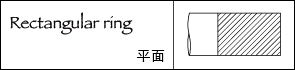
Its cross-section is rectangular. The advantages are a simple shape and easy machining, with no special curves or contours, so it has a larger contact area with the cylinder wall, which helps the piston dissipate heat. However, its run-in is somewhat poorer and its stronger oil-pumping action raises oil consumption and increases carbon deposits at the piston crown and combustion chamber, so this type is now used less often.
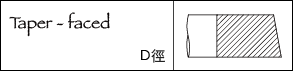
Its outer face is a cone with a very small angle (typically 30′–60′). Unlike the rectangular ring’s flat contact, the taper-faced ring makes line contact with the cylinder wall, giving good run-in and increasing contact pressure and the ability to conform to the cylinder-wall shape; but as run-in progresses the contact face gradually widens until it becomes an ordinary rectangular ring. The taper-faced ring scrapes oil on the down-stroke and spreads oil on the up-stroke. Because its contact area with the cylinder wall is smaller and heat transfer poorer, it is usually not used as the first ring.
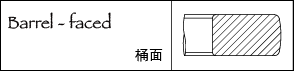
It has the curvature of a cylinder, with the ring face making arc contact with the cylinder wall, effectively avoiding edge loading and offering good adaptability to piston tilt, good sealing and good run-in. Whether moving up or down in the cylinder it forms a wedge-shaped oil film, reducing wear between ring and cylinder wall. Its main drawback is that the convex arc surface is harder to machine; it is often used as the first ring.
Its name comes from the fact that, once fitted in the cylinder, the asymmetric cross-section creates an unbalanced force that twists and deforms the ring. The twisted ring keeps the advantages of the taper ring, spreading oil on the up-stroke and scraping oil on the down-stroke. Because its up-and-down travel within the groove is shortened, it reduces oil pumping, eases impact and lowers wear; on the power stroke the ring no longer twists, so the two sealing faces make full contact, aiding heat dissipation. When fitting, pay close attention to the cross-sectional shape and the designed orientation — fitting it the wrong way round will sharply increase engine oil consumption. Its excellent oil-scraping ability means the twisted ring is often used as the second ring in a set.
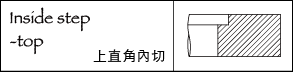
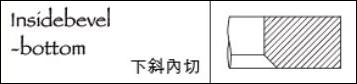
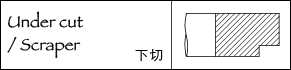
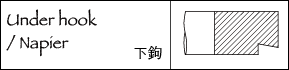
Cutting a right-angle or bevel on the inner side, above or below the ring cross-section, is collectively called an inner cut; an upper inner cut mainly increases gas-tightness, while a lower inner cut scrapes oil. A scraper cuts a right-angle notch on the outer lower edge; the similar Napier ring cuts an acute-angle notch on the outer lower edge.
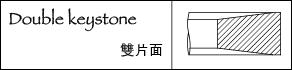
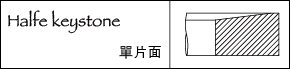
Its cross-section is trapezoidal, and its main feature is good anti-sticking, often seen in heavily loaded diesel engines. The first ring of a diesel engine easily sticks from gumming and loses its function in the groove; the keystone ring constantly shifts position as the side load on the piston changes direction, squeezing carbon out of the groove, preventing the ring from sticking and breaking, and extending service life. There is also a half-keystone ring, which has the characteristics of an upper-inner-cut ring. Keystone rings are hard to machine, require precision craftsmanship and have a lower yield, so they cost more; they are generally used as the first ring in diesel engines.


An overlapped joint cuts a right angle on the upper half of one side and the lower half of the other at the ring gap. A hook joint builds on the overlapped joint with more complex cutting so the two ends interlock; both are more often used in compressors or agricultural equipment. An internal notch cuts a trapezoid-like angle from the inside at the gap and is more often used on personal watercraft; a side notch cuts a semicircle from the side at the gap.
The shape design of a piston ring reflects not only its function but also its craftsmanship. By studying the different forms closely, we can better understand the considerations behind each design and make the right choice for each situation.
© C.T.I. Traffic Industries Co., Ltd. Original content by C.T.I. — reproduction, copying or commercial use without permission is prohibited.
Back